


Cash crops vs food crops: Which is more profitable for farmers?






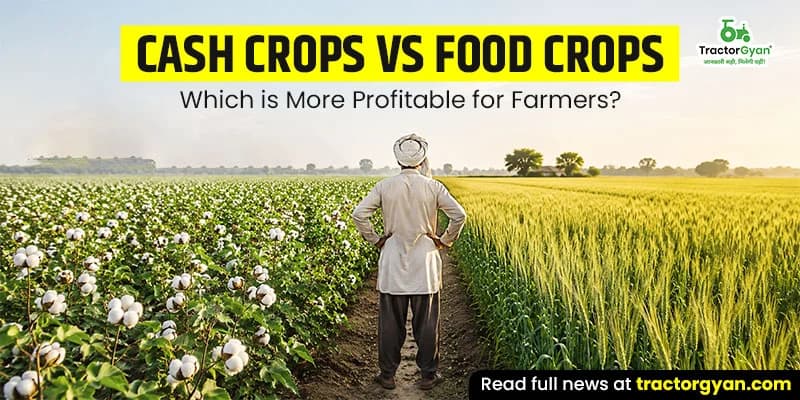
Table of Content
Farmers often face an important question before starting a crop season: should they grow crops for household consumption or focus on crops that generate higher market income? The comparison of cash crops vs food crops depends on several factors, including market demand, production costs, climate, irrigation, land size and access to buyers. Food crops such as wheat, rice, maize and pulses mainly support food security, while cash crops such as cotton, sugarcane, tobacco and oilseeds are generally grown for commercial returns. Understanding their differences can help farmers make better crop-planning decisions.
What Are Cash Crops?
Cash crops are crops primarily grown for sale in domestic or international markets rather than direct household consumption. Their production is closely linked with market demand, processing industries and commercial opportunities.
Common cash crops in India include:
- Cotton
- Sugarcane
- Tobacco
- Groundnut
- Mustard and other oilseeds
- Tea and coffee
Cash crops can offer attractive returns when prices and yields are favourable. However, they may also involve higher input costs and greater exposure to market price fluctuations.
What Are Food Crops?
Food crops are mainly cultivated to provide food for people and support household and regional food requirements. They include cereals, pulses and other crops that form an important part of the Indian diet.
Major food crops include:
- Wheat
- Rice
- Maize
- Bajra
- Pulses
- Millets
Food crops can provide farmers with a dependable source of household food. Farmers may also sell surplus production in local markets, making these crops suitable for both consumption and income generation.
Cash Crops vs Food Crops: Key Differences
| Factor | Cash Crops | Food Crops |
|---|---|---|
| Main Purpose | Commercial sale |
Food and consumption |
| Examples | Cotton, sugarcane, tobacco |
Wheat, rice, maize, pulses |
| Income Potential | Can be high |
Generally more stable |
| Market Risk | Higher |
Comparatively lower |
| Input Requirement | Often higher | Varies by crop |
| Price Dependence | Strong |
Moderate to high |
The profitability of both categories changes with crop yield, input costs and selling prices. Therefore, farmers should avoid selecting a crop only because its market price appears high.
Quick Links




Which Is More Profitable for Farmers?
There is no single answer to which crop type is more profitable. Cash crops can generate higher commercial returns when farmers have suitable soil, irrigation, reliable buyers and favourable market prices. For example, crops linked with processing industries can provide strong demand when market conditions remain supportive.
Food crops, on the other hand, can reduce a farmer's dependence on purchased food and provide relatively predictable demand. They may be particularly suitable for farmers who prioritise household food security and have established local markets.
Factors Farmers Should Consider Before Choosing a Crop
Farmers should evaluate the following factors before deciding between cash crops and food crops:
- Market demand: Check local and regional demand before planting.
- Production cost: Compare seed, fertiliser, irrigation, labour and machinery expenses.
- Climate and soil: Select crops that match local growing conditions.
- Water availability: Avoid crops with high water requirements when irrigation is limited.
- Selling facilities: Access to mandis, processors, traders and storage can affect returns.
- Price risk: Consider how sharply the crop's market price can change.
Can Farmers Grow Both Cash and Food Crops?
Yes. Crop diversification can help farmers balance income generation and food security. A farmer may dedicate part of the land to food crops for household requirements while using the remaining area for commercially attractive crops.
Intercropping or crop rotation can also help improve the utilisation of available land and resources, depending on the crops and farming conditions.
Why Trust Tractor Gyan?
Tractor Gyan is India's Trusted Agri-tech Platform, providing farmers with reliable and easy-to-understand information on tractors, farming practices, agricultural machinery and the latest industry updates. Our content helps farmers make informed decisions with practical insights and relevant information.
Category


Read More Blogs

For farmers looking for dependable power for their regular tasks, the Swaraj 735 FEeR is a practical choice. It has been available in the 31-40 HP range and offers a mix of a 3-cylinder engine, robust hydraulic system, intuitive operator controls,...

अगर आप मध्य प्रदेश में खेती करते हैं और नया ट्रैक्टर खरीदने का बजट अभी नहीं बन पा रहा, तो परेशान होने की कोई बात नहीं है। सेकंड हैंड ट्रैक्टर आज के समय में बहुत ही समझदारी भरा ऑप्शन बन गया है,...

If you've been tractor-hunting anywhere near a paddy belt in India, chances are someone's already told you to look at the Kubota L3408. And honestly, that advice isn't wrong. This compact 34 HP machine has quietly built a reputation as one of...
Write Your Comment About Cash crops vs food crops: Which is more profitable for farmers?
.webp&w=1920&q=75)
Top searching blogs about Tractors and Agriculture
.webp&w=2048&q=75 "Top 10 Tractor brands in india")
26 May 2026
26 May 2026
29 Jul 2025

08 Sep 2025

17 Jun 2026
30 Jul 2025

19 May 2026
01 Jun 2026

15 Jun 2026

30 Jul 2025
09 Feb 2026
.webp&w=2048&q=75 "Top 10 tractors under 5 Lakhs")
19 Mar 2026
.webp&w=2048&q=75 "Top 12 agriculture tools in India")
18 May 2026

26 Dec 2025